

Two of the most famous and largest food retail chains in Israel.
There isn't an Israeli who hasn't heard of Shufersal or Rami Levy, and it's hard to find an Israeli who lives here and hasn't visited one of their branches at least once in their life.
Their branches are spread throughout the country. Millions of Israelis visit them every month. Men, women, and children, religious and secular, Jews and Arabs—they enter a branch (the "super"), buy food products or cleaning supplies, stand in line at the checkout, and leave with a shopping cart and bags, loading them into the car waiting in the parking lot.
There are other food chains in Israel, big and small, but Shufersal and Rami Levy, together and each one separately, are as Israeli as it gets—in their historical story, their image, their work style.
Even in their names: both have Hebrew names with an associative connection to Jewish heritage. Shufersal and Rami Levy are names that roll off the tongue and are easy to say. For Hebrew speakers and Arabic speakers, for English speakers or Spanish speakers. In Russian language Amharic language... and this too is an advantage in a country of immigrants like ours, where most citizens came from other countries and spoke different languages.


The most common supermarket signs in Israel. On the right: Shufersal, on the left: Rami Levy
Shufersal and Rami Levy are part of the landscape in the Israeli space.
Like: a Kupat Holim (HMO) or a Matnas (community center), like Ben Gurion Airport or Herzl Street.
Shufersal is the elder. It came first, right after the State of Israel was established. Rami Levy came twenty years later.
Shufersal has many more branches and employees, its financial turnover is larger, as is its national market share. Rami Levy, officially named "Rami Levy Shikma Marketing"—is located far behind it, in second place in the ranking of food retail chains, but far ahead of the next places in the ranking.
And more than all the others—Shufersal and Rami Levy are burned into our consciousness with a common denominator and many small nuances that distinguish between them.
The common denominator is clear and simple:
These are two giant corporations that each employ thousands of workers and turn over billions of shekels every year. Both are the largest food retailers in Israel, with a huge variety of products. Every manufacturer or distributor wants to place their goods on one of the shelves in their branches.
And the difference?
Each chain has a different style, a different image, a different story that touches the Israeli experience—and these can explain why consumers shop at one supermarket, even though the other is right next to it, close by.
The bottom line: Shufersal is a brand of quality and responsibility, for families of the middle class and up. Rami Levy is a popular brand for the poor and also for the rich who want to buy cheap.

Rami Levy

Shufersal
Hidden beneath the bottom line are historical and social lines that explain it. Here are a few of them:
Shufersal is a respectable business corporation, an anonymous entity of capital owners. A limited company, which is traded on the stock exchange and publishes annual balance sheets. It has shareholders, a board of directors, and only a very few people in Israel know who they are. The company's managers and owners have always belonged to the business elite in Israel, the one with the ties and the pedigree. They met each other at business conferences and cocktail parties, moved from managing one company to managing another in the Israeli industry and commerce sectors.
Rami Levy is also a limited company that publishes annual balance sheets and is even traded on the stock exchange—but that's Rami Levy. He is the CEO, the founder, and its sole owner, and he is surrounded by his closest family members. Rami Levy is a man. Of flesh and blood. You can see him. "Touch" his character. Even before he became a billionaire, and maybe even after—it feels as if you know him. When you leave his branch and something bothers you, you can imagine yourself turning to him directly and complaining.
Shufersal was established in the early years of the state. Its founders, all capital owners who belonged to the milieu from which the ruling hegemony came—Jews from Western countries, who spoke among themselves in standard Hebrew spiced with English and Yiddish, and knew who to turn to to close business deals.
Rami Levy started operating in the 1970s, in the Mahane Yehuda market in Jerusalem. He himself, the son of a family of Kurdish origin, did not belong to any business elite. His Hebrew was the Hebrew of the market and he sold the goods in his store to consumers in the area who wanted to buy cheap, and when he earned a little, he opened another store and then another.


Rami Levy, the founder, owner, and CEO of the Rami Levy Shikma Marketing chain
A nostalgic meeting of CEOs at Shufersal.
From right to left: David Weinshel, Yosef Geva, Effi Rosenhaus, David Alfandari
The Shufersal chain is managed as is customary in the business world.
There's a main management and above it a board of directors, and below it vice presidents and divisions. Its management policy is classic, everything in it is measured according to economic parameters learned in academia and in the economic world. They emphasize a high-profit margin, promotion of growth engines, utilization of sales areas, market research, and marketing efficiency—all by the book.
Rami Levy didn't study at university, and didn't even finish high school. He is dyslexic. God gave him commercial senses and he works with them alone. That's how he started, with a small store in the market, and that's how he continues to work even after he manages an economic powerhouse. He buys goods for 100 shekels and sells them for 105 shekels. He earns less per unit and reaps the profit from the large sales volumes.
Shufersal is aimed at the middle class and up to the top decile. Its branches are located everywhere Israelis from these classes live. These are clean and orderly branches that provide a pleasant and distant transactional shopping experience, and you can't be mistaken about the guiding hand from above.
Rami Levy is aimed at the lower socioeconomic strata, but not only. He offers a unique shopping experience that presents the consumer with a market atmosphere. Anyone who enters a Rami Levy branch senses that in this branch they save on operating expenses so that the price will be lower. This kind of shopping experience can be suitable for those who have no money and also for those who do but want to save.
And there's more:
Shufersal opens a branch in an urban neighborhood and calls it: "Shufersal Yesh," a name that implies availability and efficiency.
Rami Levy opens a similar branch and calls it: "Rami Levy Neighborhood" (Rami Levy Shchunah), a name that emphasizes a personal, neighborhood connection.
Shufersal pays a lot of money to famous presenters to star in advertising campaigns.
Rami Levy is the presenter for Rami Levy.
At Shufersal, low-level managers are sent to be interviewed by the media. Rami Levy knows all the consumer affairs reporters in the media. He interviews himself with them.
Several of Shufersal's managers throughout the generations have gotten into criminal trouble, and have been involved in financial scandals.
Rami Levy was honored to light a torch at the torch-lighting ceremony on Independence Day 2015.
**************
This is more or less a summary of the story of Shufersal and Rami Levy.
And after understanding the small nuances that distinguish them, you can also understand why when Shufersal distributes fat dividends to its managers and shareholders, it annoys the Israeli consumer who feels as if they are living off their back and financing them.
And when Rami Levy pulls in fat dividends, no one dares to get into his pocket. Simply: because that's Rami Levy.

That's Rami Levy.
You already know him.
Historical Bit:
The first branch of Shufersal was opened in Tel Aviv in 1958, on a central street in the city's prestigious area, in a luxurious urban environment where the middle and upper classes lived. It was the first supermarket opened in Israel, heralding the opening of markets and retail chains—with a cash register and shopping carts. Its opening was accompanied by protests from grocery store owners and labor organizations who understood that they were losing their livelihood.
The branch still exists there today, and besides the sign at the entrance, the place has no historical or social value. The place does not attract interest, and the only visitors are consumers who live in the area.

The first branch of Shufersal on Ben Yehuda Street in Tel Aviv
Rami Levy opened his first store in a side alley near the Mahane Yehuda market in Jerusalem, in an old and neglected area. This store still exists there, and the street where it is located, Shikma Street, is named after its original name ("Shikma Marketing").
This store has become a tourist attraction—it is part of tour guide programs. Tour groups of travelers in Jerusalem arrive at the alley every day, hear from the guide about its history, and take pictures there as a souvenir.
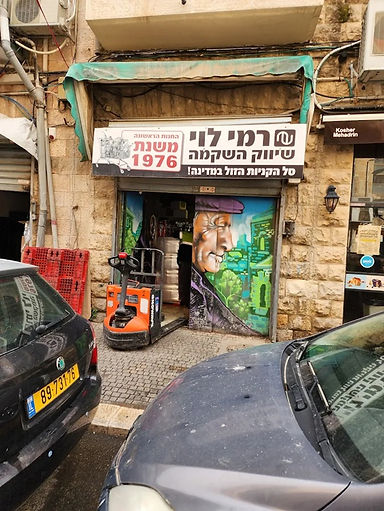
A tourist attraction: The first store of Rami Levy Shikma Marketing in Jerusalem.
From here, Rami Levy's empire grew.
This is part of "The Israeli Story 1948-2025" project.
What is "The Israeli Story"?
A curated selection of Israeli snapshots, those that were and still are with us. Each one deserves an updated definition with a few words of explanation along with a tiny bit of history. Just a little – and all of them together go into the virtual Israeli Story that will remain online for future generations. You can see what's included in it by clicking on the icon below.
