

First stop: The years 1948-1956
The Genesis:
How the IDF Military Bands Were Born
Israeli culture doesn’t pin a single "Day Zero" on the birth of the military bands.
There is no specific calendar date, no clearly defined starting point, and no single Performance troupe that can be crowned as the sole progenitor of the phenomenon.
In fact, this was never a single band, but a large and diverse collection of different musical groups established over decades. It was an evolutionary process that began even before the State of Israel was a reality, and before Israelis had a formal, organized army.
The earliest seeds were sown during the British Mandate, within the Jewish Resistance Movement that fought against British authority and the Jewish Brigade—a unit that fought alongside the British against the Nazis in World War II.
There, within improvised military frameworks, during nighttime lulls between battles, scenes unfolded that became an inseparable part of the emerging military ethos: a group of fighters huddled around a campfire—a "Kumzitz"—when one of the guys would burst into song, sweeping everyone else into a spontaneous chorus.
The phenomenon gained momentum. Local commanders realized that these scenes were a potent "morale booster" (as they’d call it today), and they began recruiting young men with acting and singing abilities from the outside to come and "make the guys happy."

The Palmach (the elite strike force of the underground) took this idea and refined it after World War II.
Staff officers gathered a small group of young singers and actors with stage talent and organized them into a structured framework, similar to entertainment troupes found in other armies around the world.
Thus, the Chizbatron was born.
Its members were all roughly the same age as the combat soldiers they entertained. They didn't just sing around a fire; they presented an "Artistic Program"—a full-blown show with songs and satirical sketches.
For its time, the Chizbatron was an original, innovative, even revolutionary idea. It was a kind of rebellion against the heavy, solemn theatrical style that had dominated cultural life in Mandate-era Palestine. Its creators brought the soldiers in the field a new kind of entertainment: rough, ready, and unfiltered.
They had a director who guided them in what was then called the “staging of songs”—movement and positioning that illustrated the lyrics through simple theatrical motion. A sort of "virgin choreography," if you will.
The Chizbatron wasn't alone.
n the years before independence, similar musical groups existed within other military organizations as well, but somehow... the Chizbatron’s songs claimed a dominant spot in the Israeli soundtrack. It was etched into history as the "Mother of all Military Bands"—partly thanks to Haim Hefer, the legendary lyricist who knew not only how to write the songs but also how to market them and generate some serious PR.
The Chizbatron’s lifespan was relatively short.
When David Ben-Gurion declared Israel’s independence and established the IDF, he dismantled the Palmach. The dismantling of the Palmach led to the dissolution of the Chizbatron.
The band’s founders were certain they’d be called to continue their mission in the new, organized army, but—as often happens—clashes of ego and rivalries between officers meant the band couldn't find its place in the IDF. The founders tried to relaunch it as a civilian troupe, but that attempt failed as well.
The IDF tried to promote similar ideas but struggled initially. Here and there, small entertainment "cells" wandered among the soldiers, but the output wasn't impressive, and they left almost no historical footprint.
The Chizbatron performing "The Homeless Returnees" (HaHozrim Lelo Bayit) at the end of the 3rd Palmach Convention, 16/10/1949
To watch on YouTube, click the link here.
The turning point came in 1950.
This was the year the "Firstborn" of the modern bands hit the stage: The Nahal Band, with its first original and unique program.
Why the Nahal?
Nahal—an acronym for No’ar Ḥalutzi Loḥem (“Pioneering Fighting Youth”)—was a semi-military framework established after the declaration of the State of Israel and the fixing of its borders.
The Nahal (Fighting Pioneering Youth) was a unique semi-military organization established after independence. Its core purpose was to inational priorities that were considered vital at the time: military service and the pioneering of border communities that served as a shield against enemy infiltration.
The Nahal existed on the seam between the army and civilian life.
Eighteen-year-olds, graduates of youth movements, were drafted into the Nahal. Yet their service was divided between periods of military training and periods devoted to civilian routines. They were assigned to agricultural work in remote border communities, strengthening the civilian presence along Israel’s frontiers.
Realizing the pioneering ideal was a top priority for Nahal commanders.
Alongside it came additional objectives, like education and instilling values in the great "melting pot" that was the new State of Israel.
At the very bottom of the priority list was a seemingly minor item: entertainment and morale. This was handled by junior officers who experimented with various ideas, including the discarded notion of a military entertainment troupe that could serve as an educational tool—promoting pioneering values and the spirit of volunteering.
The idea grew from the bottom up...tdriven by the persistence of a few “true believers."
Two years after the IDF's founding, and after extensive preparation, the Nahal presented its new-old product: A military band made up of young conscripts—talented youngsters who could sing and act on stage.
The Nahal Band’s first show was titled "Mirik Mistaderet" (Mirik Manages)—a sort of musical with a plot centered on a female Nahal soldier named Mirik, Set against the singular social milieu of the Nahal—that peculiar blend of soldiering and pioneering.
With this show, they set out to boost the nation’s spirits.
This was the "In-house Band" of the Nahal organization. Its members were sent to perform in frontier outposts manned by Nahal units and at training camps for youth groups preparing to serve in these border communities.
Almost all the songs and sketches in their early programs focused on the specific Nahal ethos—a blend of farming, pioneering, and military life.

.png)
The Nahal Band’s first program ran for about a year.
It was followed by a second, third, fourth, and fifth. Within a few years, the band became famous. These talented youngsters knew how to sing and how to make soldiers laugh. Their songs spread by word of mouth and were soon played on the radio—the one mass medium that reached communities across the country.
Over time, Nahal commanders, pleased with the results, began "volunteering" their band for state ceremonies. For example, during the founding ceremony of a new border village, the band would provide the "artistic portion" of the event, following the inevitable fiery oratory and pompous rhetoric of political apparatchiks.
They were invited to perform on civilian stages during Independence Day in big cities. From time to time, they even performed in cultural halls in cities and regional councils for civilian audiences.
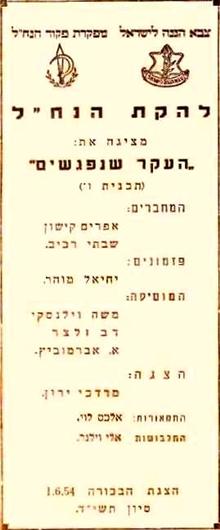
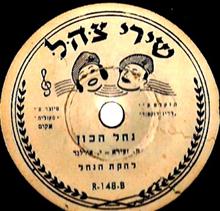

(From right to left) Nahal Band program, 1952; Band record, 1953; Band program, 1954. all these - in hebrew Click images to enlarge.
The success of the Nahal Band encouraged the creation of similar bands within the IDF's regional commands.
Education and culture officers in the three major commands established bands that carried their region's name: the Northern Command Band, the Central Command Band, and the Southern Command Band.
The format was identical: Each band was a military unit composed of ten to fifteen soldiers—men and women of enlistment age (around eighteen)—with acting skills and the ability to “carry a tune.” All were recruited with a single purpose: to entertain the soldiers in their command and raise morale. They performed funny sketches, sang about military life, and were accompanied by an accordionist—also a member of the band.
Each unit operated under the authority of an education or culture officer, who was responsible for producing a program that would run for several months before being replaced by a new one. These officers recruited professional creators to write original content, musical arrangers, and directors. They also handled the logistics—everything from stage props to the vehicles needed to transport the band from base to base—and managed the performance schedule.
These four original bands were quickly absorbed into the cultural fabric of 1950s Israel.
The media of the day was highly ideological, focusing on the pioneering spirit, and that is how they treated this emerging culture. The radio devoted entire prime-time programs to the bands, and the Hebrew press covered the phenomenon extensively—sometimes with a critical eye, sometimes in warm and enthusiastic language, rich in superlatives. They described a group of singing youths performing with an accordion for soldiers during training breaks, laughing at jokes about the Sergeant Major's mustache, the life of a recruit in boot camp, civilian and military bureaucracy, and the "commander who is always right."
The Nahal Band remained the "first among equals" and the most successful. Behind the Nahal performers stood officers whose daily work involved contact with civilians, intellectuals, and officials in the agricultural communities. For them, it was easy to understand the importance of culture and entertainment as a necessity for 18-year-old boys and girls drafted into the army.
The other bands, in the commands, were a secondary concern and ranked low on the list of priorities. There, Large headquarters were occupied around the clock with building an army that had only just been established and was already rapidly expanding. The "Massive Aliya" (immigration) from all over the world doubled Israel’s population, including young new immigrants who reached draft age, doubling the IDF’s manpower within years.
Senior officers were focused on building military power, managing large forces, and securing massive supplies of weapons and ammunition. Their supreme mission was clear: to protect the borders of the state—borders that were exposed to terror attacks on a near-weekly basis—and to prepare for a war that could break out at any moment.
Entertainment for the soldiers?
Sure... okay... if there’s time between drills, bring in some singers and actors to lift their spirits. If it doesn't help, it certainly won't hurt. That’s what the Education Officers are for.

.png)
Eight years after the founding of the state, the IDF received the opportunity to prove its capabilities. It happened in the first war led by its own commanders.
The military band was there, too.
About that, and about the years when the bands solidified their place in Israeli culture, at the next stop on our journey in the footsteps of the ethos... in the next chapter: Operation Kadesh and the Years that Followed.
This is a chapter from the musical monograph on Israel’s IDF military bands—an extraordinary cultural phenomenon that flourished between the wars and shaped the music and culture of Israel for over 40 years.
The full monograph spans eight separate chapters, including an introduction, summary, and table of contents. You can explore the complete series by clicking the link below:
Research, Writing, and Editing: Shlomi Rosenfeld
