

Floor washing, Israeli style.
Sponja is a concept that every Israeli knows, and understands that here, we don't just "wash the floor," we do a "Sponja" – one short word that rolls easily off the tongue and expresses one of the most basic household chores that exists in every human society. To do a sponja is to do what people do in every nation, in every country, but with an Israeli, Jewish touch.
How it Works ?
Essential tools: A round plastic or wooden stick attached to a rubber strip (the squeegee, or "Magav" in Hebrew), a rag or a sponge also called a "floor rag," cleaning materials, and of course, a bucket of water.
The method: Individual, with different variations for wringing out the rag, washing, and reusing the water. There is no standard that dictates how to do a sponja; the main thing is for the floor to be clean (or shiny – depending on who walks on it every day, and how meticulous they are).
The correct posture: Bent back. It is advisable to stretch sometimes. Sometimes you need to kneel and scrub dirt from the floor that the water can't clean.
Direct speech: You do a sponja. There is no other way to say it in Israeli Hebrew. There is no other linguistic inflection.
.jpg)

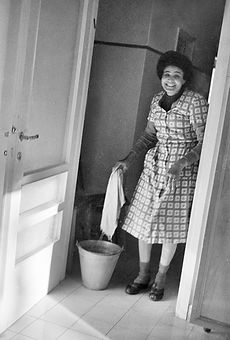
The Israeli sponja traditionally and stereotypically belongs to the woman – it doesn't matter if she is a housewife, a homeowner, or a cleaning lady.
The stereotype prevents the average Jewish man from holding the squeegee and rag – unless he is a bachelor or a divorcé living alone, or he is married but advocates for gender equality and a fair division of the burden in the family, or a broke student who is forced to fund his studies with cleaning jobs in other people's homes.
In the 21st century, with the rise in the standard of living, the advancement of women in society, and women entering the workforce – more and more women are passing the sponja stick to foreign workers from Asia, Africa, or Europe. And if a woman has enough courage and isn't afraid, and the security situation is calm and no terror attacks have been recorded – she will hire an Arab from the Palestinian Authority.
Either way, in every case and in every situation – the woman in the home continues to bear the ministerial responsibility for the work and its results. The husband almost never interferes.
Outside the family's apartment door, in the residential building's stairwell, they no longer do a sponja, but wash the floor, and this is done by men and women, people who have to earn a living somehow.
Despite all of the above, there is one place where Israeli men will hold a squeegee and rag out of circumstance.
They are all young men aged 18-20 and they are soldiers serving in the IDF. There, at the beginning of their military service, they wash the floors of their rooms at least once a week, by command, in preparation for the weekly 'cleaning inspection'.
And yet, no one there in the army demeans these young men by saying they are "doing a sponja." For them, it is a necessary chore, and what they do is a forced cleaning – they pour water and "pass" a squeegee with quick strokes, without a rag, from the corner between the wall and the floor, to the door and from there outside.

More about Sponja and its status in Israeli culture:
-
Comprehensive explanation of the Sponja chore: Israeli Sponja by Teddy Weinberg.
-
Sponja challenges: to lift chairs, move beds and sofas... and put everything back in its place. Intended for diligent people who do a good job.
-
"Slipshod sponja": Without moving furniture. To wipe with a single-use wet rag on the visible tiles. Not even to wet the floor under the sofa or bed.
-
Recommended day: Friday. To adhere to an old stereotype that is still in effect in many sectors, especially in religious sectors. According to this stereotype, the house must be clean and ready for Shabbat – a day when the whole family gathers together, at least for one festive meal.
-
S.E.X. day: Speaking of Friday, which is a short day before Shabbat and the last of the regular weekdays, there is a common Israeli slang expression that defines Friday as "sex day," and it's not what it sounds like. This "sex" is an acronym for three Hebrew words whose meanings are: Sidourim (errands), Kniyot (shopping), Sponja. These are routine chores that a great many Israelis are busy with on this day, which is not part of the regular work week in Israel.
For English speakers who want to have fun with a translated phrase: Sponja, Errands, Xtensive chores. -
Sponja Model 2000: An electric squeegee, wireless washer, and dryer. The electric devices have not yet penetrated every home because many Israeli women do not trust robots of any kind and insist on washing with the squeegee and rag, just like their mothers did.
-
Industrial sponja: A bulky robot with a rotating disc that cleans thoroughly, including wax and polish. Such a massive cleaning is only done when moving apartments and you don't trust the cleanliness of the previous tenants.
-
Condescension: "You want me to do a sponja?" – a rhetorical question heard from the mouth of a macho man, a son of a patriarchal family where a woman's status and roles are clear, and include: sole responsibility for cleaning the house.
-
A shout from inside the house: "Why did you enter the living room, can't you see the floor isn't dry from the sponja yet?" Such a shout is part of a routine scene in an Israeli home with children who insist on wandering around the house while their mother is cleaning and doing a sponja.
-
Cleaning sickness: Doing a sponja three times a week. Yes. There are also such obsessive clean-freaks. They wipe the dust from the furniture frequently, wash the dishes themselves because they don't trust a dishwasher, wash their hands at every free moment, and shower at least twice a day.

Historical Bits
Sponja's origin: Probably in ancient Greece, from where the word spread to other peoples in Europe and rolled on to Spanish-speaking countries. (Sponja – Esponja – sponge).
Israel's sponja represents a history of social classes.
At the end of the 19th century, it was brought by Jews who immigrated to the Land of Israel from Turkey, Greece, Spain, Bulgaria, and the Balkan countries. They spoke Ladino, which is a unique language of Jewish descendants of the Spanish exiles.
Many of them were part of the upper class in the urban centers of Jerusalem and Jaffa. They employed an Arab cleaning lady who cleaned the house with an absorbent rag – "sponja" in their language.
At the beginning of the 20th century, when Jews from Russia and Poland came here in the first waves of immigration, they pushed aside their predecessors who had already settled in the country, took over the Jewish settlement and also conquered the upper-class layer.
The sponja – a short and practical word that rolls off the tongue more easily than "floor washing" in any language – survived the change in classes and hegemony, and was passed on to the new cleaning ladies.
The cleaning lady was a woman who belonged to the "Sephardic" communities – a code name for Jewish immigrants from Islamic countries, who were then a small minority in the Jewish settlement.
After the establishment of the state, hundreds of thousands of immigrants arrived from all the diasporas, including hundreds of thousands of Jews from Islamic countries who remained in a lower social stratum and were called "Mizrahi " The Mizrahi men went out into the workforce to make a decent living, and their wives and daughters went to do a sponja for the European Israeli (Ashkenazi) bourgeoisie.
The most sought-after were women who immigrated from Yemen and were known for their diligence. "My Yemenite" was a code name used by nouveau riche Ashkenazi women in the 1950s and 1960s when they spoke about their cleaning lady with a complaint or a compliment.
In the 1970s and 1980s, new waves of immigration arrived in Israel from Europe, this time from the Commonwealth countries, and the sponja stick was passed into the hands of new immigrant women, who spoke Russian or Ukrainian.
After that, women from Ethiopia came here and pushed aside their predecessors. The Ethiopians already did a sponja for families from all communities – Ashkenazi and Mizrahi who had climbed into the upper deciles.
In the 2000s, cleaning companies arrived and took over a significant share of the sponja market. With them there are no social classes, there is only the bottom line of profit.
This is part of "The Israeli Story 1948-2025" project.
What is "The Israeli Story"?
A curated selection of Israeli snapshots, those that were and still are with us. Each one deserves an updated definition with a few words of explanation along with a tiny bit of history. Just a little – and all of them together go into the virtual Israeli Story that will remain online for future generations. You can see what's included in it by clicking on the icon below.


