

Hapoel, Maccabi, Beitar
Three of the largest and most important sports organizations in Israel.
All of the clubs in the Israeli top-tier leagues of football and basketball, and also in most other sports—are connected, in the past or present, to one of these three organizations.
Among the three, "Maccabi" and "Hapoel" are the largest. They are the foundation of football, basketball, athletics, and all the well-known sports in the country for over 100 years. And since then, most sports clubs in the country use these names as their primary identity, typically followed by their city's name. Maccabi and Hapoel teams from the same city are considered rivals, even bitter rivals. Every game between them is a "Derby" which arouses interest and attracts a large crowd of fans from the two rival teams.
Beitar is the smallest of the three, and is known to Israelis mainly in the field of football, and only in Jerusalem and Tel Aviv.
So what's behind the three most common names in sports—the ones you see on players' jerseys, on billboards in sports fields, and in articles in all media outlets?
Here are some details from the present, with the addition of historical bits from which you can learn about their status in Israeli sports, and their influence on Israeli society:


The Beitar logo
The Maccabi logo
The Hapoel logo
Hapoel
(Israelis pronounce it with a semi-stress on the second syllable: ha-PO-el. With an emphasis on the "po.")
Ha-po-el is the largest in Israel.
It's an umbrella organization with the most sports clubs that carry its name. Its size and prevalence across all sports are related to the history of Israel, and to the veteran establishment that ruled the country for many years.
Its name alludes to the idea behind its establishment at the beginning of the 20th century: sports for the working class.
Ha-po-el began operating as the sports arm of the "Histadrut"—the largest workers' organization in the country. The organization was part of the establishment that led the Hebrew Yishuv and later the State of Israel from the day it was established.
The Histadrut accumulated great power for many decades, and its arms controlled the economy, health, culture, and all aspects of life in Israel. By virtue of its status and power, it made sure to channel money for the establishment and funding of teams and activities in all sports, even for non-profit.
The red, socialist color served as the background for the flag and the emblem in the organization's clubs, and the emphasis was ideological: sports activity for the masses, and especially for the working class.
Their slogan was: "Sport for the thousands and not for the champions."
Behind the slogan was the guiding principle: winning and achievements are important, but in second place. The main thing is sport as a value in itself, for the individual and for the collective.
In the 1980s, the veteran establishment died out, and with it, the Histadrut died out until it completely disintegrated from all its arms and was re-established in a different format.
Ha-po-el, its sports arm, remained an umbrella organization that advises and guides. Its name continues to be emblazoned on the jerseys of male and female players in basketball and football teams, but each of the teams is independent and managed by owners or non-profit organizations.
The idea of sports for the masses did not completely die.
Ha-po-el continues to operate significantly in the popular sports—in which it not only advises but also supports and participates in the organization of events.

Maccabi
(Israelis pronounce it with a semi-stress on the first syllable: Ma-ka-bi. With an emphasis on the "KA.")
Maccabi is an umbrella organization for sports clubs, the second largest in Israel.
The organization was established at the beginning of the 20th century, and its founders gave it the name "Maccabi," which represents a myth of historical Jewish heroism.
Since its establishment, Maccabi has operated clubs in all sports. The club's activists belonged to the middle class and were established separately from the "Hapoel" teams, the rival organization. The difference was clear: "Ha-po-el" represented the working class and the importance of sports for the sake of sport. The Maccabists emphasized competitiveness and achievement, and the aspiration for Olympic achievements.
The clubs carrying the name "Maccabi" are managed independently and are not supported by the umbrella organization, but they receive guidance and advice from it.
The central enterprise of the Maccabi organization is the "Maccabiah" event, which takes place every four years, and in which Jewish athletes from all over the world compete in diverse sports.

Beitar
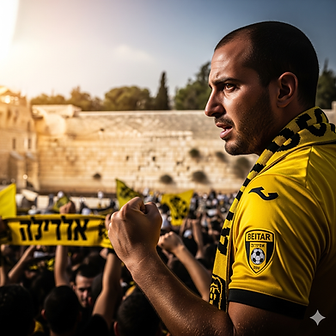
Beitar is the smallest of the organizations, and it belongs to the worldwide "Beitar" movement—a movement based on national ideas and located on the right side of the political map.
The fans of the Beitar clubs, unlike others, are identified in Israeli society with political and social worldviews, related to the parent movement.
Israelis know Beitar mainly thanks to the football club "Beitar Jerusalem," which is considered one of the most important teams in Israeli football. But there are other sports clubs associated with the Beitar movement, in the fields of football, basketball, tennis, and judo, and more.
These three organizations—Maccabi, Ha-po-el, Beitar—in fact, sustain Israeli sports.
On a national level, the rivalry between them is sportive, and if needed, they cooperate.
On a municipal level—it's a completely different story. A story of historical rivalries between Maccabi and Hapoel and between both of them and Beitar.
The most talked-about rivalries, in football and basketball, are focused on the three major cities—Tel Aviv, Jerusalem, and Haifa. There is a constant tension there between the clubs that belong to Maccabi, Hapoel, or Beitar.
This tension is fueled by loyal fans, and it is saturated with stereotypes, symbolic colors, social classes, and memories from the past.
Here are the most prominent ones:
Maccabi is blue or green and also yellow, and is often on the winning side. Maccabi has a lot of money, it's professional, and it takes cups and championships at a dizzying pace, in Israel and around the world.
Supporting Maccabi is often seen as the most mainstream and broadly national choice. You don't have to belong to a specific social class or a political party. You don't have to humiliate the rival or hate them. Just watch the game and wait for the result. The Maccabists' coaches did the preparation as they should, and you can trust the players to put on a good show and bring another cup or championship.
Beitar is football fueled by passion, grit, and frequent controversy.
Beitar is Jerusalem. It's yellow and Jewish national. It's the Likud party, and everyone who is to its right on the political map. The Jerusalem club has a respectable number of championships and cups and has "die-hard" fans who influence the team's moves, the players, the coaches, and the club owners who change every few years.
Ha-po-el is first and foremost the red color.
The Israeli stereotype assumes that a red fan is the son of a family of European origin, he is a nerd, and he chooses one of the parties that are in the center of the political map or a little to the left.
According to this stereotype, Hapoel fans belong to the veteran stratum in Israeli society, the sons and grandsons of the generation that established the State of Israel and whose leaders ruled in politics and society.
This is a deep-rooted fandom that passes from father to son, fueled by a lot of nostalgia—for the days when Israeli society was run according to idealistic codes, back in the first decades of the state's existence. The veteran fans of Hapoel are strongly connected to the Israeli music that was played then on the radio or the turntable, and even today they continue to listen to the songs of singers from the past, led by Arik Einstein—the most famous Hapoel fan of all time.
The loyal fan of Hapoel Tel Aviv, Hapoel Jerusalem, or Hapoel Haifa—is reminiscent of the Labor party, in its current incarnation: he's a kind of loser who lives on memories but does not give up and maintains his unit pride even in moments of decline.
His life's mission: to beat Maccabi. And at the same time, if possible—also to take a championship or a cup.


This is part of "The Israeli Story 1948-2025" project.
What is "The Israeli Story"?
A curated selection of Israeli snapshots, those that were and still are with us. Each one deserves an updated definition with a few words of explanation along with a tiny bit of history. Just a little – and all of them together go into the virtual Israeli Story that will remain online for future generations. You can see what's included in it by clicking on the icon below.


