

This Is How We (Not) Speak
- Cursing and Insults in Israel -
Every Israeli, like every other person in the world, has that moment when they curse, insult, and express themselves with words considered "not nice."
And just like in all languages, in Israel too—swearing, cursing, insults, derogatory nicknames, and negative wishes are part of spoken Hebrew. And accordingly, so are the predictable reactions: "Don't talk like that!" or "Don't speak like that near the children."
The list of curses in Hebrew is long.
We have a hot and cold land, good and bad people, security pressure, and a variety of other reasons that cause a person to curse and insult once in a while. If not someone, then something—the situation, the neighbor, the woman driving on the road, the HMO call center representative, the government minister, or the referee on the soccer field.

The range of curses and insults is large and vast, in Hebrew and in a variety of languages spoken here in Israel—Arabic, Russian, Yiddish, English, Turkish, Amharic, and every other language from another land from which Jews arrived here to live together and speak with and about each other.
From time to time, attempts are made to compile them all in one book—a "Curse Dictionary" or an encyclopedia. Occasionally, they make a newspaper article out of it, a topic in a blog forum, or a Facebook group. All of these can be pleasant entertainment, but they are accurate only at the time of their writing, and their validity expires a few years after publication.
Ultimately, after distilling all the "not nice" words and expressions that have been, and are still being, heard in Israel for 75 years, we are left mainly with linguistic creations related to the space we live in—a lot of Hebrew, and a little Arabic.
Hebrew is the official and non-official language of speech, and it is also the language in which people curse and insult.
Those that came from other languages of other nations have not become common property. They hold their ground within the family, the group, or the community, and are part of preserving its heritage. Over the years, they remain ethnic folklore, and good material for academic researchers and media personnel looking for a piquant item for Independence Day.
Here are some of the most common curses and insults in Israel, those that have been with us for many years and have become ingrained in daily spoken language.
Those that deserve to be included in The Israeli Story 1948-2025 project.

There are the Milder Insults.
Those that can be said out loud while remaining normative. Such as: Tembel (idiot/fool), Idiot, Metumtemet (stupid female), Tipesh (stupid male), Stumah (Airhead/Dumb, fem.)—these are words that somehow pass the barriers of politeness and culture.
"You are such an idiot" or "You're just stupid" can hurt but still remain on a reasonable level. The cursed can be mildly offended, feel guilt, and try to understand why you are an idiot and why she is stupid.
In the same category are Ahbal (for a male) or Ah'bla (for a female), borrowed from Arabic. They can be defined as a term of endearment, in the best case, or a slight offense in the worst case. The same applies to H'amor (Donkey/Ass) and Dafuk (Screwed up/Messed up)—with possible additions: Dafuk ba'sekhel (messed up in the head) or D'fuka be'ramot (messed up to the extreme).
There are insults that describe Character Traits: Shakran (liar), Kamtzan (cheapskate/miser), Natzlan (exploiter), Rasha (evil/wicked), Tzavu'a (hypocrite), Maniyak (bastard/jerk), Mefager (Retard/Behind the times), and Holeh Ruach (mentally ill/crazy).
These are descriptions based on the judgment of the curser and their momentary anger, and they are not always true. If someone tells you that you are a liar, that is open to debate, and you can prove otherwise.
Nokhel (Swindler/fraudster)—that's a step up. The insult describes character and systematic deceit. It's difficult to defend against. The same applies to Mush'hat (Corrupt), which became very popular in public discourse in the late 20th century.


There are the Crude Insults.
These are the ones that leave the mouth when the curser loses control and bursts into swearing and vulgar words—words that come from the hidden world of male and female genitalia. They usually leave the mouth when there aren't too many people around. It is customary to censor them publicly—on radio and television, they are neutralized by a beep, and in newspapers, only the first letter is noted, followed by three dots.
The most common ones were borrowed from Arabic, and they are: Kus Emak (your mother's female genitalia). Or Kus Okhtak (your sister's female genitalia). They are considered "crude" because they are related to the female genitalia, but they are already fundamental, ingrained items in Israeli slang, and there is no one in Israel who hasn't heard them and perhaps even used them. Including the addition: Kus Em-Emak (emphasis on 'mother of your mother').
Reserved Israelis with "good manners" would not dare to utter such words. The maximum they can manage, when they are boiling with anger, is to filter through their lips Ssss'em'ak or Sss'okhtak. As if it's something between themselves, but it's not terrible if a few other ears hear it.
There are also Smart-Alecks or H'nunim (nerds/geeks) who sanitize the vulgarity and say, with a slight distortion: Kushel'imah'shcha (your mother's [vagina]), thus sparing themselves from explicit mention of the harsh words.
In the family of popular crude words are also: Zona (whore/bitch), Ben Zona (son of a bitch), or Bat Zona (daughter of a bitch). And also: Mizdayen (f—ker/one who f—ks) with active inflections like: Lech Tizdayen (Go f—k yourself).
Those influenced by the Arabic sphere will also say Sharmuta (Arabic: whore/slut).
Those influenced by the Russian sphere will say Kibinimatt (Russian: f—king mother, or mother f—ker).
Those influenced by the American sphere will say Fuck You.
Another word that is not refined is: H'ara (Shit/Crap). If someone told you that you are a "piece of shit"—they meant to insult you. The H'ara—feces that underwent linguistic manure and describes something stinky, not good, not effective. You can refine it with the addition H'ara ba'leben (White shit/White crap).
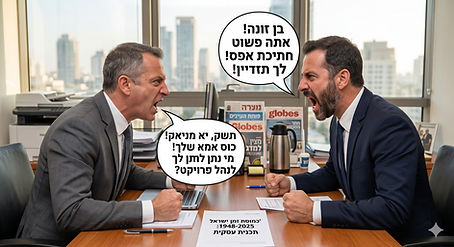
The Ultimate Insult—is surprisingly not crude.
Efes (Zero) is one of the peaks of the insulting and intolerable curses. "Ata Efes" (You are a zero) or "Efes me'upas" (Absolute zero), or simply "H'atichat Efes she'kamokha" (A piece of zero like you)—diminishes the stature of the cursed, and brings them down to the lowest level.
Nivzeh (Contemptible/Vile) is an insulting, hurtful curse, suitable for someone who did something particularly vile.
Zevel (Garbage/Trash)—is also insulting and humiliating.
Khel'ah (Scum/Filth) is an extreme expression of anger full of a difficult feeling, and frayed nerves. When there is still air in the mouth, and to reinforce the curse, they add Khel'at HaMin Ha'enoshi (Scum of the human race). Such scum deserves a spit in the face, should disappear from your sight, be imprisoned, face a firing squad, be erased from the face of the earth.
There are also Wishes for Harm that are difficult to hear.
Halvay Shetamut (I wish you would die) is a wish and a curse. It has a strong sound: Alvaysh'tamut—as one word with a 'shva' under the 'shin'. It is said with great intention and with all one's heart.
Such dark wishes also include: Shetisaref Ba'Gehinom (May you burn in Hell) or She'Elohim Yikach Otcha (May God take you).
And speaking of God...
In the religious society, and especially the ultra-Orthodox, they pride themselves on clean language. And indeed, a religious person who uses foul language like a secular person is not a common phenomenon, but they too are human beings and they too get angry and annoyed, and curses and insults are heard among them, which may not be crude or "dirty," but their community knows what was meant by the person who uttered them.
Shikse is the ultra-Orthodox replacement for the word Zona (whore).
Bur Ve'Am Ha'aretz (Ignorant boor/Unlearned person) is the replacement for an idiot or a fool.
Rasha (Wicked) or Okher Yisrael (Underminer of the Jewish People) are derogatory nicknames for other Jews who do not behave according to the ultra-Orthodox codes.
Yimach Sh'mo (May his name be erased) is a common wish, and in severe cases, it comes with the addition: Yimach Sh'mo VeZikhro (May his name and memory be erased). Other common ones: epithets that come from Jewish myths, filled with negative figures, such as: Haman HaRasha (Haman the Wicked), Amalek, Hitler, Satan, and Nazi.
The ultra-Orthodox and the religious, and all believers in the Torah of Israel and the Bible, make extensive use of curses and insults against enemies and the wicked. They are found in the prayer book (Siddur), they are in the Torah and the Talmud. The peak is found in the Book of Psalms written by King David, in Chapter 109:
Appoint a wicked man against him; let an accuser stand at his right hand.
When he is tried, let him come forth guilty; let his prayer be counted as sin.
May his days be few; may another take his position.
May his children be fatherless and his wife a widow.

Cursing and insulting are the ultimate release for anger.
It is the most primitive, the simplest, and the most convenient. Some would say it is even human. On the 75th birthday of the state, its citizens have become accustomed to hearing curses not only at home and in the street but also from the mouths of leaders, rabbis, and officials, and even in its most respectable dwelling: the Knesset (the Israeli Parliament). The parliament of the people's representatives.
On television and social networks—they make headlines out of it.
In life—all of Israel are guarantors for each other and insult each other, and it is impossible to go through an entire life without uttering an insult once in a while.
This is part of "The Israeli Story 1948-2025" project.
What is "The Israeli Story"?
A curated selection of Israeli snapshots, those that were and still are with us. Each one deserves an updated definition with a few words of explanation along with a tiny bit of history. Just a little – and all of them together go into the virtual Israeli Story that will remain online for future generations. You can see what's included in it by clicking on the icon below.


