

When the sun sets and evening descends upon Israel, thousands of Jewish women from all over the country leave their homes with a wash bag in their hands. Women in Jerusalem and women in Tel Aviv, in Rishon LeZion and Petah Tikva, in Mevaseret Zion or in Tiberias. Each of them knows the way and is familiar with the structure located close to her home, which she walks toward.
It is usually a building that is not prominent in the landscape.
It may be located at the edge of an urban neighborhood or in a side alley, or on the outskirts of a dirt road in a moshav (cooperative village) or a local council. The sign at its entrance is modest, and sometimes it does not exist at all. But those who need to know already know—her husband, her mother, her friends.
At the center of the structure is a small pool of water with a shallow depth, enough to cover an average person's body, and everyone who arrives will enter the pool for an immersion of purification.
Thousands of Israeli women, in various locations across the country, perform the immersion process monthly, and others arrive for a one-time immersion in the discreet structure, where activity is bustling—from sunset until the late hours of the night.
Its full name is "Mikveh Taharah" (Ritual Bath of Purity).
In Hebrew and all languages spoken in the Jewish public, it is known by its abbreviated name: Mikveh, with penultimate stress and emphasized pronunciation of the first syllables: "Mick-ve."
As of 2023, there are about 1,100 public Mikvehs in Israel. 200 of them are intended for men belonging to the ultra-Orthodox sector.
All the others, about 900 Mikvehs, are intended for women only. The majority of the Mikvehs in Israel were established for them, in every city and every Jewish locality.
And just like the external discretion, the activity inside it is not discussed in the discourse between Israeli men and women, despite its wide distribution and its impact on the lives of millions of families in Israel.

The vast majority of adult women in Israel have immersed in a Mikveh at least once in their lives.
This is how they integrate into an ancient tradition that has been part of the Jewish heritage for thousands of years.
The regular immersers are married women of childbearing age, who come to the Mikveh once a month after dark. These women, and their families, lead a lifestyle based on "Taharat HaMishpacha" (Family Purity)—a basic concept in Judaism.
As part of the strict adherence to "Taharat HaMishpacha," married couples are forbidden from having sexual relations during the period when the woman is menstruating. During this period, she is considered "Tameh" (ritually impure) and must refrain from all physical touch with her husband until the menstrual cycle disappears. After she is sure of her physical status, she must immerse in the Mikveh to return to being "Tahor" (ritually pure), and only then is she permitted to resume sexual relations with her husband.
It is not only married women.
Each month, around 4,000 Jewish brides-to-be arrive at the Mikveh before their wedding, and hundreds of other women who undergo a conversion process every year and are obligated to immerse to become part of the Jewish people, and other women from all ends of the social spectrum who see immersion as a purifying experience, both spiritually and physically.

Every month, about 140,000 immersions take place in the Mikveh. This is according to a report by the Religious Councils in Israel.
The first encounter of the Israeli woman with the Mikveh takes place on her wedding day.
Every woman who marries in a Jewish ceremony is obligated to immerse. This is a necessary condition for receiving an official marriage certificate from the State of Israel. Even if the bride is secular or is not fully comfortable with the ancient purification ritual, she has no choice but to immerse and provide certification of it. Otherwise, no Jewish rabbi will perform the wedding ceremony for her. The Chief Rabbinate, which is responsible for marital affairs in Israel, will not issue a legal marriage certificate to a woman who has not fulfilled this obligation. And without it, she and her husband cannot receive a document legally recognizing them as husband and wife.
After the wedding, women continue to immerse, according to their worldview and the lifestyle they have chosen.
Secular women suffice with this single time that was imposed upon them.
Religious and traditional women who strictly adhere to "Taharat HaMishpacha" continue to visit the Mikveh regularly—once a month or a few times a year.
In 2022, the Israel Democracy Institute (IDI) published a report based on social surveys, which shows that the percentage of women reporting that they immerse at least once a year is segmented as follows:
Ultra-Orthodox—almost 100%,
National Religious—42%,
Traditional-Religious—38%,
Traditional-Not-So-Religious—18%,
Secular—less than 2%.

A Mikveh in Moshav Mabu'im, Merhavim Regional Council.

The central women's Mikveh in Nahariya.
The immersion takes place in the presence of a Balanit—a woman whose role is to assist the immersers and supervise them in order to fulfill the commandment of immersion according to the rules of Jewish law (Halakha).
The rules require the immersion of the entire body, without "Hatzitza" (interposition or barrier). That is: the water must cover every point of the woman's body. Therefore, she is required to remove clothing, jewelry, makeup, or nail polish.
The immersion process begins by entering the Mikveh and paying a fee to the Balanit, who directs the woman to a private preparation room. In this room, the preparation stage takes place: the woman removes every possible barrier and ensures thorough bodily cleanliness (full washing, hair combing).
Afterward, she calls the Balanit, who accompanies her to the immersion room. The Balanit ensures there are no barriers, and then the woman descends into the water. The woman immerses several times according to her custom, while reciting a blessing. The Balanit supervises the validity (Kashrut) of the immersion. After finishing the immersions, the woman ascends, dries herself, and gets dressed again.
Besides the public Mikvehs for women, there are dozens of private Mikvehs called: Boutique/Spa Mikveh.
They are considered luxurious, of a particularly high standard. With extra-large bathing tubs, illuminated mirrors and a makeup corner after immersion, spa treatments and massages, soft and pleasant robes and towels, and even hot drink corners and light refreshments.
Wealthy people from the ultra-Orthodox sector pamper themselves with a private Mikveh inside their apartment, one that serves both the man and the woman.
Public Mikvehs are subsidized by the state.
The visit fees range between 20-80 NIS, and in the Boutique/Spa Mikveh, prices are much higher, ranging between 200-350 NIS, including all accompanying services.

A room in a luxurious Mikveh, "Hasdei Taharah" in Haifa.
The Mikveh for men is a completely different story.
There are about 200 Mikvehs for men in Israel, and they are located in concentrations of the ultra-Orthodox population in cities like: Bnei Brak, El'ad, Jerusalem, or Beit Shemesh. They stand out in the landscape, and the signs on the structure can be clear and large.
Men's Mikvehs are mass Mikvehs with two or three immersion pools in each building, a row of showers and seating benches, in the style of old bathhouses, with a social atmosphere. Their main activity is on Sabbath and holiday eves—then, thousands of men come to them to perform a custom whose essence is: spiritual preparation in honor of the Sabbath or holiday.
The men's immersion is short and quick (a few minutes) and does not require preparation or accompaniment by a Balanit.
This is an immersion that does not carry the nature of a religious obligation.
It is a custom that has gained momentum in recent centuries, with the growth of the Hasidic movement in Judaism, and has also spread to other streams within the ultra-Orthodox sector.
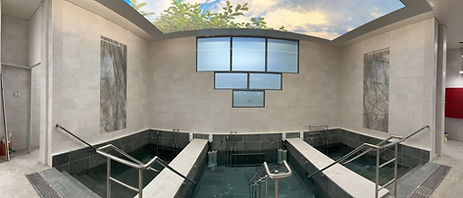

The Chabad Hasidic men's Mikveh in Kiryat Malachi. (Above: The immersion pools. Below: The assembly and seating hall, designed for social gathering.)
The construction of a Mikveh requires particularly challenging architectural planning and execution.
A basic principle in purification according to the rules of Jewish law requires that the immersion be done in rainwater. To implement this principle, a drainage system must be prepared, and a special pool must be established into which the rainwater drains. From there, the water flows to the immersion pool, after being filtered by water purifiers.
Mikvehs, especially for women, are planned with an emphasis on modesty and discretion, which is why the design is restrained and does not attract attention.
Mikvehs, for men and women, are common in Israel, and constitute an inseparable part of the Jewish lifestyle in Israel and around the world.
Here, with the image, you can find a detailed list, including a search engine, of all the public Mikvehs in Israel and in Jewish communities around the world.
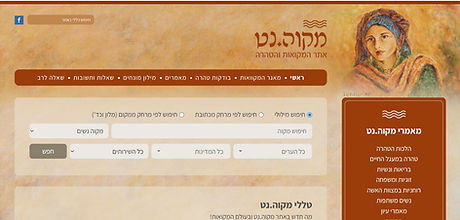
The homepage of the Mikveh.net website with a search engine for Mikvehs in Israel and around the world. Click on the image or the link here.
This is part of "The Israeli Story 1948-2025" project.
What is "The Israeli Story"?
A curated selection of Israeli snapshots, those that were and still are with us. Each one deserves an updated definition with a few words of explanation along with a tiny bit of history. Just a little – and all of them together go into the virtual Israeli Story that will remain online for future generations. You can see what's included in it by clicking on the icon below.
