

A Jewish holiday celebrated in Israel every year for eight days, and mainly eight nights.
Compared to other holidays in Israel, Hanukkah is ranked as secondary in importance.
It has the hallmarks of a holiday, such as: a traditional ritual, unique foods, prayers, and blessings—but all of these are integrated into the daily routine and do not necessitate a fundamental change in the schedule of work and commerce. Like the Purim holiday celebrated about two months later—it is merely a brief respite between the major holiday season (Rosh Hashanah and Sukkot) and the Passover holiday; a taste of tradition and folklore with an opportunity to strengthen roots and heritage; another reason for a party and to lift the family and communal spirit, without disrupting the routine.
The reason for the celebration: thanksgiving to God for the "Miracle of Hanukkah" that occurred about 2,000 years ago. A summary can be read below, and in detail: in the Hanukkah article on Wikipedia.
The central symbol of the holiday: a candelabrum with eight branches for lighting eight candles, and one additional, separate candle outside the row (called the Shammash). In Jewish heritage, it is called "Hanukkah Menorah," and in spoken Hebrew, which every Israeli knows: Hanukkiyah.
The Hanukkiyah stands at the center of a fixed candle-lighting ritual every evening, whose purpose is to remember and remind the people of the Miracle of Hanukkah.

Hanukkah is a winter holiday.
Its first day is set according to the Hebrew calendar, on the date: 25th of Kislev. Corresponding to the Gregorian calendar: sometime between the months of November and December, with the possibility of some of the days extending into January.
The weather is wintry, ranging from rain, cold, and even snow, to a winter sun that breaks through the clouds. The days are very short, the sun sets very early, and immediately upon nightfall, the festive and significant activity begins: the Hanukkiyah candle-lighting ritual.
The ritual is performed according to traditional rules passed down from generation to generation and has not changed for about 2,000 years: on the first evening, one candle is lit—the first candle. On the second evening—two candles... and so on until the eighth evening when eight candles are lit. In addition, one more candle is lit every evening, which is located in the center of the Hanukkiyah, standing out of the row (the Shammash).
The candle lighting is a family affair, and according to tradition, it is managed by a man, usually the father of the family. The more extended the family—the more reason for a family gathering, with the option of inviting relatives and friends.
In religious and traditional families—the candle-lighting ritual is an obligation and a mitzvah (commandment), and they perform it for eight evenings, one after the other, according to the rules of Jewish law (Halakha) with blessings and hymns of a religious nature, unique to Hanukkah. Immediately after the ritual, the celebrants taste one of the holiday foods—a Sufganiyah (doughnut) or a Latke (potato pancake).
In secular families, they do not adhere to a fixed ritual and suffice with a one-time hosting or participation as guests in others' candle-lighting events, where they will also snack on holiday foods and sing popular songs related to Hanukkah, songs with a traditional and national character.
In various communities, a central candle-lighting ritual is held for a large audience, usually on the first evening of the holiday. This is an opportunity to gather the community members and instill content that will be part of its consolidation.
This is also done in all IDF bases spread across the country, in community centers, in assisted living facilities, in hotels, and in cultural halls. Subsequently, everyone will perform the ritual, if they wish and according to their worldview, in their own home or in the homes of others.

2003 - President of Israel, Reuven Rivlin, at a candle-lighting ritual with IDF soldiers. (Photo by Mark Neiman, GPO)
The most noticeable place where the holiday is felt: in the education system.
During the eight days of Hanukkah, educational institutions in Israel begin their holiday break—from kindergartens to high schools. The relatively short holiday slightly disrupts the parents' arrival at work for a week, but at work—it's business as usual. Most employers make sure to share the holiday spirit with employees and hold a one-time event where they will distribute Sufganiyot and light symbolic Hanukkiyah candles.
In the entertainment business—there is a lot of action. There are many children and teenagers on vacation, and they are the target audience for festivals, plays, and movies. In the religious sector, they utilize the Hanukkah evenings for unique performances with a religious/traditional character. And both these and those are held in closed halls and not under the open sky. The cold weather requires participants to arrive with coats and umbrellas.
The tourism sector is relatively quiet.
This is not a "scorching season" because Israelis do not have a special reason to go on vacation and leisure. Tourists from abroad arrive in Israel not because of Hanukkah but because of the Christian holidays, Christmas and New Year's, which are located close to Hanukkah on the calendar, and they are a good reason for pilgrims and believers to visit their holy sites, such as: Jerusalem, Bethlehem, or Nazareth. And if, by chance, one of the Hanukkah days "meets on the calendar" with the Christian holidays, they will experience a charming combination of Christmas tree lights and Hanukkah candles.
Anyone visiting Israel during one of the eight days of the holiday will find a country where everything proceeds normally, with only various hints scattered across the landscape: here and there, one can see an electric Hanukkiyah lit in public buildings and on the streets of the large cities, long queues to buy a Sufganiyah at bakeries and pastry shops, mothers and children near entertainment halls, and traffic jams on the roads leading there.
On the media channels, they will mention the day in passing, the television will broadcast short clips of candle lighting in an IDF unit or a remote settlement in the north or south, and will return to the regular entertainment programs.

A Hanukkiyah with electric bulbs on the water tower of Kibbutz Be'eri.
Hanukkah is a holiday for all Jews in all their dispersed communities around the world.
In Israel, the Jewish state, the holiday days combine religious and national symbols that accompany the daily routine in a unique setting with representative traditional items.
Here are some of them:
-
The Sufganiyah—a fried dough confection heavy with calories, filled with jam or chocolate. The Sufganiyah was brought to Israel by immigrants who arrived from European countries, and over the years, it gained the status of a national food. And it has a sister called: Sfenj, which is comprised solely of sweetened fried dough, and it arrived in the country along with the Jews who immigrated to Israel from the Islamic countries in Asia and North Africa.
-
Sevivon—a traditional toy that stars as a game of chance among children and teenagers. Today, only a few use it, but it remains a symbol.
-
Dmei Hanukkah (Hanukkah Money)—a traditional custom in which children receive a small sum of money from grandparents, uncles, or aunts for current spending. This custom is also no longer really common today, but the term still exists.
-
Songs for the Holiday—among them religious songs, and songs with a secular/national character.

Hanukkiyah, Sufganiyah, Sevivon
Historical Bits
The story of the Miracle of Hanukkah is passed down from generation to generation and drives the holiday tradition for over 2,000 years.
It is based on a historical event during the period when Jews lived in the Land of Israel under an autonomous framework, led by the Hasmonean dynasty.
The essence of the story: a revolt led by the Hasmoneans against the Greek ruler who oppressed them and dared to desecrate the Holy Temple, the most sacred place in the history of the Jewish people. The leader of the revolt, Judah the Maccabee, succeeded in defeating the foreign army, liberated Jerusalem, and after purifying the Temple, the House was rededicated.
The Dedication of the Temple (Hanukkah) is the ideological basis for the celebration.
The symbol representing it: a Menorah that was found in the Temple. Its candles burned for eight consecutive days, even though almost no oil remained in the branches. A real miracle—which is the Miracle of Hanukkah, expressing the divine assistance for the Jewish victory over a large army of a vast empire.
For two thousand years, Jews in all their dispersed communities around the world celebrated the idea of the miracle, perpetuated the special connection of the people with God who protects them in times of trouble, remembering and mentioning it again and again through the lighting of the candles, and a prayer of thanksgiving to God for it.
The name of Judah the Maccabee was omitted from the heritage, and the prayers and blessings were directed toward the heavenly miracle.
Hanukkah was celebrated modestly, mainly centered around the candle lighting every evening in the family circle, and was considered just another item in the heritage narrative of the Jewish people exiled from their land and scattered among other nations.
The holiday commemorated the special relationship of the people with God who protects them in times of trouble.

A Hanukkah Menorah from Poland, 18th century,
in the Israel Museum.
At the beginning of the 20th century, when the Zionist movement began its activity, the holiday acquired additional nuances.
Zionism refined the new Hebrew nationalism in the Land of Israel, at the expense of pushing aside religious ideas. The movement's ideologues, most of whom had a secular worldview, sought to disconnect from the diasporic heritage and inject new ideological blood into the DNA of the Jewish people. They did this by combining narrative terms that fit the Zionist vision: the aspiration to establish an independent Jewish state in the Land of Israel.
As part of this ideological reorganization, the Hanukkah story received additions and updates that commemorate Jewish heroism and the courage to raise one's head and not surrender to oppression by other nations. The part of Judah the Maccabee stood out, elevated to the rank of a national hero who dared to stage a revolt and bring about the revival of the Jewish people.
When Jewish settlement in the Land of Israel began anew, driven by the Zionist movement, Hanukkah entered the list of national holidays. The education system of the Jewish Yishuv (pre-state community), which operated under the British Mandate, went on an eight-day vacation. During this time, the story of the heroism of Judah the Maccabee and the Hasmonean army was instilled in the young generation.
The myth consolidated throughout the Jewish community—popular songs were sung in their honor, streets in the large cities were named after them, and social and sports organizations were established bearing the name "Maccabi," which acquired a national flavor.
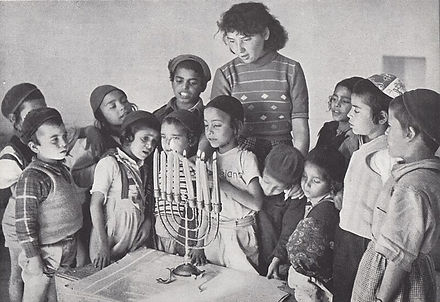
1952 - Kindergarten children
in a Ma'abara (transit camp) light Hanukkah candles.
The Zionist narrative of Hanukkah consolidated after the establishment of the state in 1948.
At that time, the phrase "Me'atim Mul Rabim" (The Few Against the Many) was also added to the Israeli myths—a phrase that expresses the Israeli spirit of the small Jewish state. The three words were inspired by the Hasmonean wars and glorified the courage to fight against numerous enemies who fight it and surround it from all sides.
In the first decades of the state, the days of Hanukkah continued to bear the symbols of heroism and courage. The shapers of Israeli society incorporated the holiday songs, in the Zionist spirit, while the songs of thanksgiving to God were pushed slightly aside but did not completely disappear.
The candle lighting continued to be performed according to tradition and did not change the basic format of a low-tier holiday, one that does not stop the daily routine. Hanukkah became a family holiday with an emphasis on passing down the heritage to children. They received "Dmei Hanukkah" (Hanukkah Money)—a symbolic sum of money that adults would give them for current spending. This custom is also no longer really common today, but the term still exists. They played with the Sevivon (dreidel)—a type of game of chance with religious elements. And they ate the sweet Sufganiyah with jam.
Since the beginning of the 21st century, the atmosphere in Israeli society has changed. Religion and tradition have gained a broader place, also influencing the days of Hanukkah. The candle-lighting ritual now opens with the traditional blessing, accompanied by religious songs and national songs, side by side.
As the state marks 75 years, the eight days of Hanukkah continue to be celebrated in a format that combines tradition and national ideas, and does not deviate from the routine. Events and festivals are celebrated under the theme of light (inspired by Hanukkah candles). The Sufganiyah continues to star as the national food, alongside its doughy sister, Sfenj, which is comprised solely of sweetened fried dough, which was brought to the country by immigrants from Islamic countries. The Latke has been pushed slightly aside, along with the Sevivon and Dmei Hanukkah, which are no longer relevant in the era of computer games and credit cards, and children continue to enjoy a week-long vacation during which parents search for occupy their time for them.
On the eighth and final evening, the Hanukkiyot are fully lit, displaying a full row of eight candles with the fixed ninth candle (Shammash).
The next day, the public Hanukkiyot in the city streets will be extinguished, and the State of Israel will return to its regular schedule, immersed in the rains of winter.


A Hanukkah candle box found in every Israeli supermarket—before Hanukkah and even afterward—and in Jewish community centers around the world. Inside it: 44 candles, exactly the number of candles lit during the eight days of Hanukkah.
This is part of "The Israeli Story 1948-2025" project.
What is "The Israeli Story"?
A curated selection of Israeli snapshots, those that were and still are with us. Each one deserves an updated definition with a few words of explanation along with a tiny bit of history. Just a little – and all of them together go into the virtual Israeli Story that will remain online for future generations. You can see what's included in it by clicking on the icon below.
